A Special Birthday Invitation

A few weeks after we arrived back home for good last year, my phone rang and daughter Kate’s number flashed up.  When I answered, a small voice piped up “Hi Nanna!  It’s me,  Liam, and I’m calling to invite you to my birthday party.”  How could I refuse such an adorable invitation??!!  In early December I flew to Darwin and shared in the birthday celebrations of aforementioned cute five year old grandson.  Of course, his equally handsome older brother Josh wasn’t about to be outdone.  “Nanna,” he asked, “Will you come up again for my birthday?”  That sounded like a fair deal to me and it was still five months away so another visit to the Top End would no doubt be in order by then.

What I didn’t reckon on when I made my promise to Josh, was that by the time his birthday rolled around the family had transplanted themselves from their already-distant base in Darwin, to a decidedly more remote home in Nhulunbuy in East Arnhem Land!  In May this year I flew up to Cairns in northern Queensland, then connected through to Nhulunbuy on a smaller aircraft.  My fellow passengers were a mixed bunch:  FIFO (Fly In Fly Out) workers heading back to their remote workplace; Nhulunbuy residents returning from a visit to the “big smoke” for recreation, shopping, medical appointments and other necessities; and a handful of tourists and visitors like me, keen to see this wild and beautiful part of our country.

14341917_1280085828669572_188883780_n

Pontoon Jetty at Nhulunbuy – turquoise waters, even under a grey and threatening sky

Son-in-law Paul is a police officer and he and Kate seized the opportunity for adventure when they took a voluntary two year posting to Nhulunbuy.  Renowned for its fishing, four-wheel driving and outdoor lifestyle it’s a world away from the world but with most of the conveniences of home.  The MOTH suggested it was their “Pohnpei moment” – a reference to our own exploit twelve years ago when we swapped our secure (and dull) public sector jobs and our suburban existence in Perth, for an Australian Volunteers International gig, living two years on a tiny island in the middle of the Pacific Ocean.  And when I visited Nhulunbuy, I must confess the parallels between the two are striking.

Located on the Gove Peninsula Nhulunbuy is a small, far-flung township, created in the late 1960s when a bauxite mine and deep water port were established close by.  Soon after, an alumina refinery was built and during the 1970s the population swelled to more than 3,500 – a level maintained until 2013.  At that time, refinery operators Rio Tinto announced its closure; in mid 2014 the shutdown took place with the loss of more than a thousand jobs, substantially reducing the population.  Rio Tinto promised a number of measures to assist the town and the displaced workers, including subsidising the financial obligations of both business and private sector interests, who in many instances had invested heavily in building a life around the thriving town population.  At the time of my visit, these measures were still in place and it looked like business as usual to my untrained eye.  It will be interesting to see “where to from here” when the three year support period expires in 2017.  There are plans afoot to nurture the tourism potential of the area, in an effort to preserve current population levels and facilities.

I was impressed with the standard of living for most of the folks in this faraway place:  a decent sized hospital with excellent Emergency Department, general, surgical and maternity wards, and an operating theatre capable of handling a wide variety of procedures.  There are two primary schools and a high school, a respectable sized shopping centre with a Woolworths supermarket, butcher, post office, chemist, pizza shop, fabric shop and more.  Another, smaller shopping centre has a large department/hardware store as well as a café serving tasty meals, snacks and coffees.  There are a couple of pubs (permits required to buy alcohol –  it’s an indigenous community), a service station, a couple of motels, and a couple of reasonable restaurants.  Sport is all-pervasive and there’s an Olympic sized pool, a football oval, tennis courts and more.  For Kate, Paul, Josh and Liam it’s paradise found!  They revel in the outdoor lifestyle and whenever we chat on the phone they’re always about to embark on, or have just come back from, another wonderful escapade.

The Yolngu people are the traditional owners of the land (and freehold owners too, I understand), and the entire community is under the control of the indigenous Nhulunbuy Corporation.  A permit is required to drive anywhere in the area and to reach some of the more remote and pristine places, additional permits are needed.  I was lucky enough that such a trip, to the breath-takingly beautiful Cape Arnhem, was a highlight of my stay.  Accessible only in the dry season and definitely only by serious four wheel drive vehicles, the trip takes around one and a half to two hours each way from town.  Only a dozen vehicles are permitted to be in the area at any one time; this helps protect the environment but we also observed that you wouldn’t want to be meeting too much traffic coming the other way!  The first part of the trip is on primitive and increasingly rugged unsealed roads, startlingly red in colour; narrow vehicle tracks wind through sparse Top End scrub, dotted with small mountains of dung to remind you that around any corner you could come face to face with a ‘buff’ – one of the enormous wild buffalo that populate the area and which are often possessed of an unsympathetic attitude.

More than an hour into the trip our three-strong convoy stopped to deflate the vehicle tyres to low pressure.  We were about to switch from gravel tracks to sandy tracts and the softer tyres can spread out and give better traction on sand. I was relieved to learn that compressors were on board to reinflate the tyres on the way back!  Both Kate and Paul are keen four wheel drivers, and Paul has notched up many hours of experience.  But for this trip Kate was taking the opportunity to build her own skills, with Paul on board for moral and technical support.  Now I’m the first to admit I may exhibit the tendencies of a biased parent; but I also freely confess to being a nervous passenger at the best of times, let alone off road.  Kate’s driving was superb!  Not only did I relax and enjoy the experience, I was incredibly proud of her prowess ❤
nhulunbuy-5795

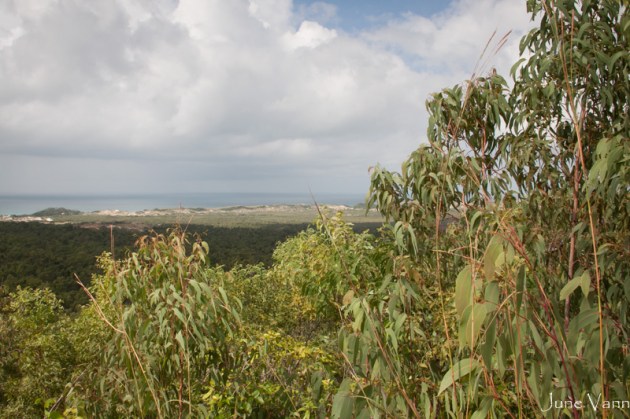
Photo stop on our way to The Penthouse

Our experienced lead driver navigated us through a veritable rabbit-warren of tracks, confidently guiding us the right way.  A photo stop half way revealed a magnificent vista from the top end of Australia, looking towards the meeting point of the Arafura Sea and the Gulf of Capricornia.  We drove along a 2 kilometre stretch of glorious white sandy beach, with turquoise waters spilling in at the edge.

nhulunbuy-5835

Is there anyone else out there??!! The beach highway at Cape Arnhem


nhulunbuy-5819

A “thong-mobile” – collection of flotsam and jetsam, created by visitors before us

Our final destination was The Penthouse – a natural clearing atop a cliff, that provides almost limitless views in either direction along the coastline.  After an eagerly anticipated picnic lunch everyone slid down the track to the beach and frolicked in the temperate shallows.  Everyone but me, that is!!  The warm, tropical waters right around the northern coastline of Australia are infested with saltwater crocs, some of which can grow to 6 metres in length.  Despite cries of “The water is so clear, you can see what’s in there,” I remained firmly on terra firma and passed more than a little time worrying about my genetic output down there in peril.  One of the standing jokes in this part of the world is that you needn’t worry about sharks in the sea, as the crocodiles have eaten them all …

My brief week in Nhulunbuy zoomed by, as we set a cracking pace to cram as much as we could into the family get together.  Josh’s birthday party, ostensibly the reason for my trip, passed in a haze of tropical heat, cake, fun games for the kids and a few drinks for the grown-ups.  Kate took me out to Yirrkala, a community some 18 kilometres away, world-renowned for its indigenous artists.  We visited the Yirrkala Art Centre where we wandered through spectacular exhibitions of art that is sold around the globe, then sat awhile to watch two artists at work – sitting or half-lying on the floor and meticulously producing the distinctive dot paintings that tell stories from the Dreamtime.

We walked with the dogs along deserted sandy beaches, feeling like we might be the only people on earth.  The island and beach at East Woody Point, and the shoreline at Rainbow Cliff were a veritable treasure trove of photo opportunities.  We marvelled at the now silent, red behemoth of the moth-balled alumina refinery that once roared with life as it processed millions of tonnes of bauxite, mined annually from nearby.  We watched the kids play soccer in the relative “cool” of the evening (temperatures in May can “plummet” to the low twenties Celsius), had our eyebrows waxed in a makeshift tropical carport-with-curtains beauty salon, drank decent coffee at the Three C’s Café under the lazy whir of overhead fans on a steamy afternoon.
nhulunbuy-5678

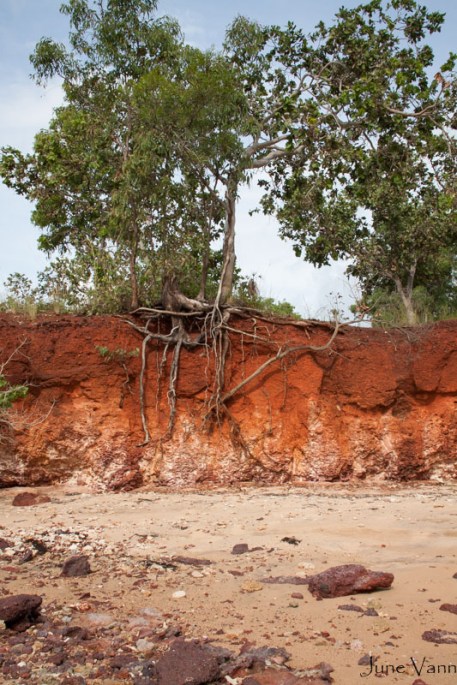
Wow! (At Rainbow Cliff)

nhulunbuy-5676

Striking colours on Rainbow Cliff shoreline

The isolation of this thriving community is what struck me most as being comparable with Pohnpei:  some 650 kilometres from Darwin, as the crow flies, Nhulunbuy is nonetheless a road trip of about one thousand kilometres!  During the wet season (roughly November to April) the roads are often cut, turning Nhulunbuy into its own version of a tropical island.  Supplies are ferried in by barge – an exercise in both cost-efficiency and practicality, since the barges can usually run all year round (tropical cyclones notwithstanding!) and carry more than a truck possibly could.  The supermarket receives new stock once a week and visiting the shops at various stages of the weekly cycle reminded me of the ups and downs of consumable supplies during our own island years.  Two distinct advantages of Nhulunbuy over Pohnpei include English being the main language, and having one’s own currency!!

When families live so far apart – commonplace on a continent the size of ours – the times together are all too few and far between.  I’m grateful that the boys are now of an age that we have a real connection and can pick that up each time we meet … but it’s still always sad to say goodbye.  Josh and Liam went a little late to school the morning I left, so they could take Nanna to the airport;  I smiled as I recalled Liam, at the age of three, confidently telling a friend in Darwin that they were off to “Nanna’s Airport” –  for him it seemed a natural connection of ownership.  With hugs and a few tears and the perennial hope that the next visit wouldn’t be too far away, we parted company and I settled in to wait for my delayed flight.  It was only after take-off, as I looked back over my shoulder through the plane window, that I noticed the unusually shaped building at Gove airport is actually an aircraft when you view it from the air.  Brilliant!

goveairport

Cool! Gove Airport from the air (picture from Google Earth)
 

Let It Snow!!

I’ve mentioned here before that I spent my childhood in the north of England until, a few weeks after my twelfth birthday, my parents opted for a brighter, sunnier Australian future for my two younger brothers and me.  I only returned to England twice during my teens but more than four decades later I can still clearly remember those cold winter days when the gloom stretched into mid-morning and drew in again by mid-afternoon.  I walked quite safely to and from my primary school and often made the trek both ways in a weird kind of daytime darkness.

Cold, damp days and nights and seemingly endless rain and wind stretched on for ages – the old gag from that part of England was, “It only rained twice this week; the first time for three days and the second time for four days.”  But when it got really, really cold the skies released a soft, white blanket of snow that magically transformed the working class streets and terraced houses. Everything looked prettier under a silvery mantle and the dazzling reflection from the snowy carpet literally brightened the days.

In possession of youth, along with its incumbent fearlessness, snow drifts were to be revelled in, not respected for their ability to take our feet from under us, or wreak havoc with a car’s hold on the road.  It would be easy to end this memory journey on a high note right here but the story continues:  after a few days, the temperature would rise enough to allow a partial thaw and suddenly we were traipsing through increasingly grubby looking slush that infiltrated our footwear and turned our clothing sodden.  A further cold snap would then set the half melted mess into icy furrows which were impossible to navigate with any confidence at all.

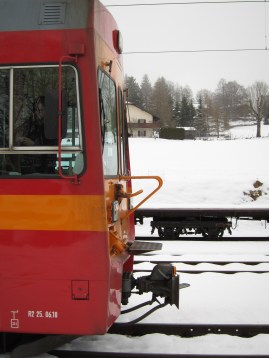
These recollections have done nothing to diminish my romantic excitement at the thoughts  of snow.  A few years back we visited Geneva in February, just for a few days – a  business trip for the MOTH that I was lucky enough to accompany him on.  Our last full day was free of obligations and, being a lover of all things railway, the MOTH had discovered a wonderful little electric line that ran from Nyon on the Lake Geneva shoreline (cue Deep Purple!!), to a tiny place called La Cure on the Swiss-French border.  We woke early, showered and dressed warmly and when we opened the blinds were delightedly shocked to find snow drifting past the window and transforming our previously unremarkable suburban view into a scene from a Christmas card.  The highlight of that day was reaching La Cure and finding the snow had settled into a ten centimetre covering all around.  I had a marvellous time stamping around in it and making footprints, watching my breath appear in little puffs of mist and admiring the sight of our beautiful red train resting at the station, against the stark white backdrop.  A delicious fondue washed down with a local red, in a warm and cosy log-cabin restaurant on the border, rounded out the experience.

Waiting train at La Cure, Switzerland

Waiting train at La Cure, Switzerland

Our return to the Ballarat area last year invoked all kinds of cautionary warnings from friends and family.  “Ballarat is so COLD!” they exclaimed.  “We know,” we replied.  “We’ve had our fill of perpetual, steamy summer and can’t wait to savour four seasons again.”  Besides, we have an excellent central heating system and when the weather’s really inclement we just batten down the hatches and watch it from our cosy living room, a good book and a hot cuppa on hand.

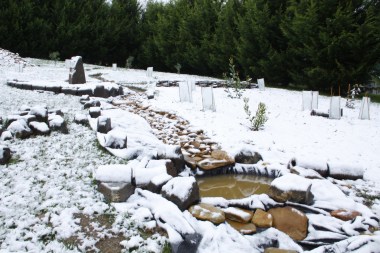
The MOTH's dry creek bed is transformed - beautiful!!

The MOTH’s dry creek bed is transformed – beautiful!!

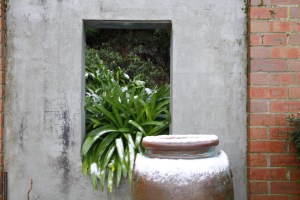
One morning last month, the MOTH woke me in the darkness that is a winter’s morning at 5.30am, with a hot cup of tea and the news that I might like to get my camera ready for when daylight arrived as the forecast snow had turned up overnight and the layer it left was sticking around!  Fortified by the hot drink and wrapped in layers of warm _MG_6008clothing, we ventured out with our cameras and smart phones as soon as the first grey light cut through the gloom.  Excited as kids, we tramped through the modest covering and happily spent an hour marvelling at and photographing this great novelty.  I did pause to reflect that our friends in North America and in Europe would have been highly amused by our excitement over such a minor snowfall!  But hey, I wasn’t about to let anyone snow on my parade that day 😉
14012282_1251848361493319_302921060_n

Now, as we come to the end of winter and we once more edge closer to our favourite star, I’m reminded that I haven’t posted my snow blog.  I want to do this before the harsh summer sun is beating down, making the memory of snow seem highly implausible … and that idea leads me along yet another thought ramble:  we spend much of our lives wishing away the hot weather and pining for a cool change; or impatiently anticipating warmth when the days are chilly.  When we’re busy doing lots of interesting things – blogworthy things – we don’t have time to write them down and post them; and when life offers a gentler pace and we have lots of spare time to write a blog, there seems to be nothing much happening to inspire us.

It makes me think what a contrary lot we humans are.  And I wouldn’t want it any other way 🙂

Well Seasoned

Imagine … living in a place where it’s never cold!  Every single day, you can leave your jumper/jacket/cardigan at home because you know you’ll never need it!  Sounds like bliss, right?  Wrong!!!  After ten and a half years of living in perpetual summer, I can’t begin to tell you how grateful I am for the infinite variety that is Victorian weather.

There is real joy in getting reacquainted with such meteorological diversity.  It reminds me in tangible ways that everything is just for a season.  We’re now well and truly into autumn and the nights are turning cooler; the warmer days are becoming fewer and further between.  I don’t mind though because I’ve had a wonderful time soaking up the bright summer days (and occasionally hiding in a darkened, air-conditioned room when it’s really too brutal to venture out) and now I’m ready for the briskness that is winter.  If it was winter all the time, I doubt I’d embrace it; likewise that endless summer I mentioned at the start of this post.  It’s the relative brevity and the changes, that make each season special and wonderful.

12935413_1159900370688119_1633862365_n

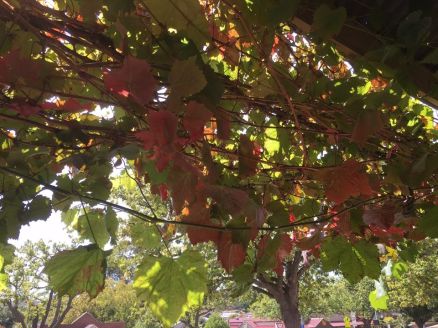
Shady grapevines in the village donning their autumn colours

Autumn in Australia “officially” begins on 1 March – though I’m not sure that Mother Nature holds much brook with such man-made officialdom.  I marvel at the things I take notice of now that I’m older, that once would have completely escaped my attention.  Like the huge shift in the position of where the sun sets each evening.  Over a period of only about four weeks I observed that the setting sun moved pretty much from one extreme of my view, to the other (a not insubstantial expanse of horizon).  The time it sets (and rises) has altered dramatically too.  A couple of months ago, it was light before 5.30am and a lovely long, lingering twilight meant nightfall was delayed till at least 9pm.  Now, darkness is chased away only a little before 7am and the evening pulls down the blinds by 7pm.  I revel in marking the passage of time in these ways, though it’s a reminder too of how quickly the years are passing by.  We’re hurtling towards our own winter at a breath-taking pace!

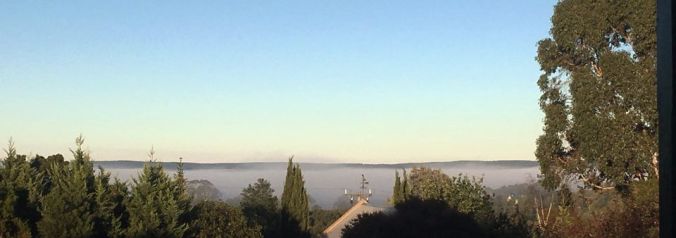
12919221_1159900360688120_1768758112_n

Low cloud in the valley makes for a magical view on an autumn morning

The cooler weather bring the pleasure of snuggling under the doona at night, and tucking toes into slippers in the mornings. This week we’ve had the central heating checked and serviced; we know it won’t be too long before we’ll be cranking it over for the first time this season.  We survived the latter half of last year’s chill with an extra blanket on the bed and flannelette sheets but we know that an entire winter will call for serious reinforcement:  an electric blanket.  I’m watching the shops for the arrival of new stock so I can buy and prepare.

Although we’re now a month into autumn, the message was underlined last week when I pulled out the cucumber and zucchini plants as they came to the end of their productive lives.  After months of eating their fruits practically daily (and preserving plenty for consumption through the winter), it’s hard to imagine we won’t be able to wander up into the garden and pick them fresh, as we need them.  Ironically, the MOTH discovered this week that he loves zucchini and corn fritters and I now find I’ll have to buy zucchini to make them!!  The tomatoes are still going – there’s enough warmth yet in the sun and the

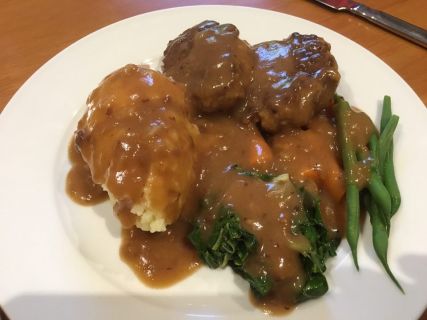
12899910_1159900354021454_1739216727_n

Practicing comfort food – under that sea of onion gravy are rissoles and homegrown vegetables!!

soil, though I expect some of the latest new, green tomatoes will never get to ripen.  One last crop of lettuce is making a pretty, frilly green splash up there too.  But now the pumpkin vines are taking center stage as they sprawl enthusiastically up the rock retaining wall behind the veggie garden.  Brussels sprouts, broccoli and red cabbage are already gathering strength from the last throes of sunshine in the soil; they’re a good, sturdy size and we’re looking forward to winter meals with our favourite brassicas.

This week has also seen me surveying the fairly pitiful state of my winter wardrobe.  It’s a meager collection, mostly amassed over the past couple of years when I travelled home from Manila for visits.  A jumper here, a jacket there, a new pair of jeans or closed-in shoes, were enough to get me by for a two week visit and even through the final couple of months of last year’s winter, when we returned for good.  But that just won’t cut it this year, as we prepare to live through the real deal – the entire cold season – and I’m just going to have to go shopping soon 🙂  As a counter to that, I probably don’t have a feasible excuse for ever buying summer clothes again.  Or summer shoes and sandals, for that matter.  My love of footwear (just like that other famous female who lived in Manila) is almost legendary, and a story for another day…

In the meantime, I plan to enjoy the glorious autumn weather.  I love all the seasons and after a year of separation from any of them, I’m always happy to welcome each one back.  But if I had to name a favourite, autumn would probably be it.  It’s golden, still mild but with crisp evenings and mornings, and mellow –  like the year’s weather has finally got it all figured out. Spring is wonderful but much more temperamental, not quite mature.  And of course, there’s always the old joke about Melbourne’s changeable weather:  anyone who says Melbourne has four seasons in one day obviously hasn’t spent a whole day there!


Aroma Therapy

Nivea

It’s wonderful how smells can transport us to moments from the past. Perhaps it’s the aroma of a particular food that conjures up the memory … though not always. A few months ago I bought a new facial cleanser: it’s a Nivea product which I chose because it looked like it would meet my needs for a modest outlay. When I opened it up and squeezed a little onto my fingers the first night, I was instantly back in my Nanna’s bedroom, standing in front of the dressing-table mirror, smoothing her cool, white Nivea Creme onto my five or six year old skin and relishing a chance to dabble in the grown-up world. The flat, dark blue tin held more than a modicum of excitement along with the thick white crème. Even more exciting was being allowed to peel back the foil cover beneath the lid of a new tin. It seemed to hold the promise of far more than a mere cold cream might warrant (so named for the cooling effect it has on the skin, apparently). Each time I use my current product, I’m amazed that it smells exactly the same as the Nivea Creme my Nanna used, half a century ago. On the back of this memory ride a whole raft of other joyful recollections.

Those happy days with Nanna would often find me draped in her soft and heavy fur coat which lived in the dark, cavernous wardrobe in a corner of her room. I’m not sure if it was real fur but back in the early 1960s it’s quite possible it was. It smelt like it might have been, in its faintly musty, softly luxurious way and it had an air of being slightly forbidden. On my Nanna it kissed her legs just beneath the knee but on me it was full length and left a fur train swishing behind me; the satiny lining was extravagantly smooth and cool on my skin. Oh, the happy hours I spent parading before the mirror in that coat, pretending to be all manner of important and mysterious people! And when I’d had enough of dressing up and moisturising, I loved nothing better than to collapse with a book into the deep, sagging depths of my grandparents’ double bed. The wilting mattress must have been a challenge to them each night as they rolled into an ungracious heap in the middle of the bed but to me it represented all that was safe and soft.

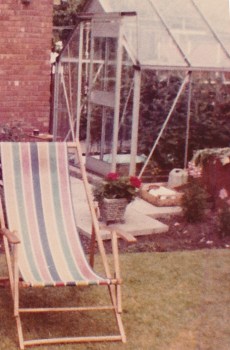
My Grandad was an accomplished green thumb and I spent many happy hours pottering with him in his beloved rose garden, and in the modest greenhouse he built to capture

Greenhouse

Grandad’s beloved greenhouse

enough warmth for a full tomato-growing season in the cool, damp climes of northern England. A paraffin heater maintained the temperature so he could plant seeds each year before the frosts outside had passed; this gave him the head start he needed and allowed the delicious red fruits to mature before next year’s cold descended. When I began growing tomatoes as an adult, my Grandad’s words floated back to me across the years, unknowingly and effortlessly absorbed as I shared that long ago gardening time with him. Pinching out the laterals, checking for bugs, carefully tying the plants up to support them … even today it’s as if he’s beside me, guiding me when I tend my own tomatoes. And oh! The smell of those sweet, ripe tomatoes defies description. A basket of rubicund treasure brought from the greenhouse to the kitchen translated into a delicious summer salad for lunch. Even more than the smell of the fruit, the smell of a crushed tomato leaf evokes more memories in a moment than any number of photos can! I wonder if my love of roses is also pinned to those lovely recollections; perhaps it’s the reason I’ve planted roses almost everywhere I’ve lived.

Junior Gardener

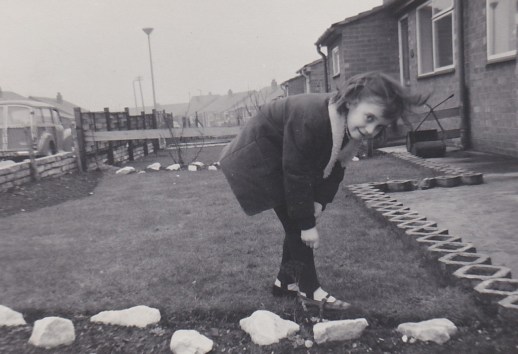
Six year old me, preparing to plant seeds with Grandad ❤

Although I don’t recall that Grandad grew them, I also associate the smell of sliced cucumbers with those summer days of my childhood. Nanna used to slice up some cucumbers and some onions and combine them with a simple mixture of water and vinegar (malt vinegar, I think) to make a type of fresh pickle. Even today as I prepare some of my

12788285_1133669273311229_231532779_n

Cucumbers in Garlic Mustard Vinegar

own pickles, the smell of cucumbers says “summertime” to me. Sunday lunch at my grandparents’ home was a regular event for Mum, Dad, my two younger brothers and me. It was most often a roast and in summer we would stay on in the endless twilight to eat a “tea” of leftover cold roast meat with salad … and pickled cucumber… and home grown tomatoes. It was a splendid meal for all its simplicity (or is that because of its simplicity?) To finish off, Nanna would open a tin of fruit – pear halves, peach slices or two fruits, usually – and serve them in fancy cut-glass dishes, topped with a swirl of evaporated milk. My Nanna’s little indulgence was to enjoy this sweet treat with a slice of buttered white bread!


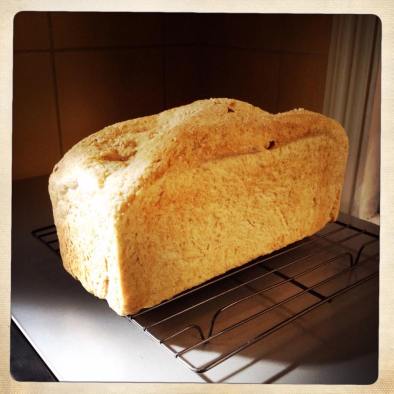
Speaking of bread, one of my earliest experiences of brown bread was Hovis wholemeal, which my Grandad consumed in generous measure. Coming from a family who had long battled excess weight and coronary problems, Grandad was told by his doctor at one point that he needed to lose weight and eat more fibre. The good doctor suggested he stop eating white bread and instead begin a routine of “two slices of Hovis a day”. Grandad (either deliberately or not) didn’t hear the word “slices” and on arriving home instructed Nanna to get the local shop to reserve two loaves of Hovis a day, which he happily devoured for the rest of his life. He lived to the ripe old age of 80 – not a bad innings for someone born in 1917, with all the limitations and hardships that era brought. I remember the great treat of sharing Hovis bacon sandwiches with him for breakfast, though I’m not sure the doctor intended bacon to be a regular feature of Grandad’s diet! There’s been a bread machine in our house since 1998 (a series of them, that is) and I’ve made almost all our bread since then. South Australian flour mill Laucke make a number of ready-to-bake bread mixes, including a golden wholemeal which reminds me of Hovis – the smell and taste take me back to those contraband breakfasts of my childhood.

Wholemeal Bread

Homemade golden wholemeal loaf

I love the power of smells and I’m deeply grateful to my grandparents for giving me so much when I was young. Their home was modest but comfortable, their activities homely but happy; what they gave me was not material goods but unlimited access to their time, attention and love. Just as it should be with grandparents ❤

(Nivea Creme tin from Google images)


The Love Apple

IMG_9601

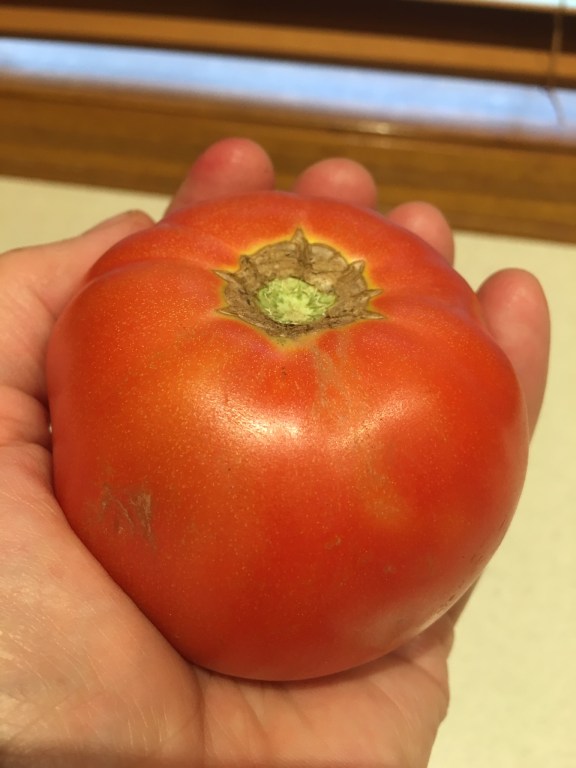
Now, that’s a tomato!!


With Valentine’s Day just gone, it seems appropriate that my thoughts turn to the love apple. Pomme d’amour means literally ‘apple of love’ – the French believed the tomato had aphrodisiac powers, hence the name. Aphrodisiac or not, I’m completely in love with solanum lycopersicum 😍 There are a few staples I’d miss desperately in the kitchen but tomatoes, along with garlic and onions, are right up there at the top of the list (olives and their oil, chili and cheese will feature another day …)

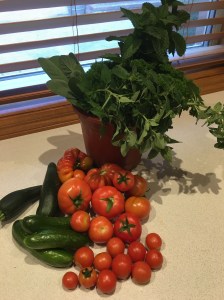
The birth of the Allan Street Flower and Veggie Collective is still a recent geological event and our kitchen garden is very much a work in progress. We’re currently using the unassumingly sized plot the previous custodians of the Collective put in place and while this has limited us on both space and soil quality, we’ve managed to cobble together a passable crop of summer vegetables. As you’ll have noticed from my recent posts, there’s barely a day gone by that I haven’t been figuring out what to do with a harvest of tomatoes, zucchinis or cucumbers. That’s not even considering the lettuce, spring onions, radishes, silverbeet and herbs – the slightly more polite summer crops which will wait patiently in the garden for a while and don’t demand to be dealt with as a matter of urgency. Tomatoes, zucchini and cucumbers on the other hand have to be picked when they’re ready, not you, and they don’t respond well to being kept waiting; neglected specimens can go yellow, go hollow, go mouldy or exhibit a variety of other tantrum-like behaviours. We haven’t had true glut levels of these veggies so big-batch bottling wasn’t on the cards, but there’s been enough to require a strong creative streak in dealing with them.

While the tomatoes have kept me on my toes – protecting them from opportunistic blackbirds that hang around the veggie patch, as well as turning them into something useful and delicious in a timely fashion – I’m not complaining. Have I mentioned that I simply LOVE tomatoes? Raw, cooked, dried … in any guise at all. I’ve already shared here the ecstasy of the tastiest semi-dried tomatoes in the world (well, in our part of the world, anyway!) But we’ve also turned out some delicious tomato relish – an old favourite I’ve been making for nearly twenty years and which has been hugely popular when spread under the cheese part of grilled cheese, on toast or muffins. A marvellous zucchini, tomato and eggplant bake with garlic and parmesan, has found its way onto our dinner menu a number of times, and a few tomatoes on the verge of going renegade (aka over-ripe) have been IMG_9713chopped and tossed into stews, casseroles and pasta sauces. A garden fresh tomato soup fittingly graced the lunch table on Valentine’s Day and was a hit. Light and delicate, fragrant like summer itself, it was quickly slurped up with warm slices of freshly baked wholemeal bread, decadently slathered with butter. There’s more in the freezer so we can recall the scent of warmer days when winter wraps its cool grip around us soon.
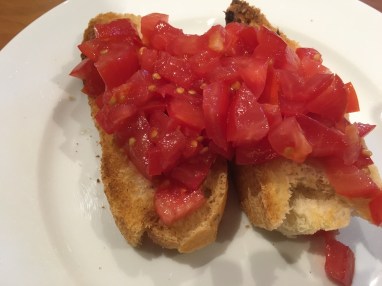
IMG_9687We’ve revelled in the sensuality of sweet, juicy tomatoes in salads, on sandwiches and savoured whole as snacks; the only way to enjoy bruschetta is when the tomatoes are as succulent as these are.  Quickly sautéed, they brighten up a plateful of bacon and eggs for breakfast. Whether the French were right or not about the aphrodisiac effect, I’ve certainly had a long-standing love affair with this amazing fruit (or vegetable, depending on which theory you subscribe to).

We once lived for two years on the small Pacific island of Pohnpei in the Federated States of Micronesia, and one of the greatest hardships we endured was a paucity of fresh food. Particularly fruit and vegetables. And above all, tomatoes… Virtually every consumable arrived on the island by container ship. The interval between ships was meant to be four or five weeks but there was usually something that stretched this out: whether it was the weather, or delays over unpaid port taxes in places along the way, six or eight weeks regularly passed between the ships sailing in. We still reminisce about the great onion drought, the long potato shortage, the-time-the-milk-dried-up (UHT only, of course, no fresh!) There was great excitement on-island when the vessel was finally spied nestled up against the wharf in the port, and the island grapevine (aka the expat phone lines) sprang to life to pass on the news, “The ship’s in! The ship’s in!”

As the chief gatherer of nuts and berries, I would leap into action and head to the store that carried the best and biggest selection of the “fresh” food; we quickly learned roughly how much time elapsed between first sighting of the ship, and when the produce hit the shelves. And you needed to be there at the shelf-hitting, to ensure an early pick at what was on offer. Ship day entailed substantial time dedicated to the gathering process. A full half day could be spent in buying and bringing home the precious cargo, then preparing it all in ways that would make it last as long as possible between ships. You could tell what stage we were at in the ship schedule by the “salads” being served at the local eating establishments: a recently arrived vessel meant we had lettuce, tomato, cucumber; half way through we were back to cabbage (lasts longer) and cucumber (one of the few veg grown on-island); by the time the next ship was due the salad was macaroni pasta with thousand island dressing!!

On reaching our stores, the produce had already been a long time picked. Usually originating from the US – sometimes Hawaii – it spent a minimum of three or four weeks at sea before we saw it. Much of it was well past its prime when it arrived but that didn’t diminish our lust for it! Every time I handed over seven or eight dollars for three or four watery, tough and tasteless tomatoes, I would head home with high hopes. And every time I tasted one of those poor, sad excuses for a tomato I vowed I wouldn’t waste the money next time. But I always did …

On our one brief trip home during our island time I stopped by the tomatoes in the supermarket and lovingly held one to my nose to enjoy the sweet, fruity aroma. My son Jake was mortified. Looking around us he hissed in a stage whisper, “Mum! What are you doing??!!” I told him I just wanted to smell the tomato. “Are you going to buy it?” he asked. I told him no, as we couldn’t take it back to the island with us anyway. “Then please … put it down,” he begged. To his teenage credit, he stopped short of physically dragging me away from the display…

A few months before we departed Pohnpei for good we were invited to the home of some US friends, to share in our first ever Thanksgiving meal, a pot-luck. It was a gathering of interesting folks from diverse backgrounds. And the really delightful thing about all pot-lucks on the island was that everyone brought along whatever special foods they’d been saving up, to share. So, that Thanksgiving we had amazing Alaskan hot-smoked salmon someone had just brought back with them from a trip to North America. Someone else brought along a decadently oozy full wheel of camembert, and there was a block of pungently mature cheddar cheese. Which the resident dog got to before proceedings really got going; needless to say the dog spent the rest of the day locked away, in disgrace. But the pièce de résistance came in the round, red form of a tomato.

The island’s Chinese embassy was experimenting with a market garden and Konrad, Pohnpei’s agricultural expert and officer-in-charge of quarantine, had been given a single ripe, luscious sample which he brought along to share, in the spirit of the island pot-luck. When he produced this gorgeous apparition and placed it, in all its rosy fecundity, in the centre of the serving table I swear there was an audible gasp from the gathering. In hushed awe every last one of us assembled around the table, as Konrad wielded a super-sharp knife and deftly carved the tomato into wafer thin slivers – one each for the 30 or so thanks-givers, who were by then giving extra thanks. It tasted like pure nectar and the fancier food items lay forgotten as we savoured that tiny slice of heaven. When everyone had slaked their desire there were two slices left over and I couldn’t help but gaze at them and wonder if they were to be wasted for the sake of politeness. The MOTH came over, put a gentle hand under my elbow and began guiding me away. “Step away from the tomato,” was the unspoken message. But I couldn’t just abandon those delectable leftovers and, made bold by long months of real tomato deprivation I went to Konrad and, in the fashion of Oliver Twist, asked for more 🙂

IMG_9543

All shapes and sizes

I’m already dreaming up ways we might extend our future tomato growing seasons here at the Collective, and not looking forward to the totally unromantic store bought tomatoes we’ll have to face when the current one ends. I waxed lyrical to the MOTH today, about the old Italian way of eating only what’s in season or what you’ve preserved from the season. We’re still a long way off being able to provide for ourselves year-round but with so many pommes d’amour in my recent diet, I’m totally in love with the idea of it!

Iron Man

ironing bored

(Image from Google)

My brother (aka Baby Bear, but who prefers “rka Baby Bear” – reluctantly known as) is a great ironer. Is “ironer” a word? Well, it works for me. As one who has suffered a life-long aversion to the task, I admire anyone who not only gets the ironing done but actually enjoys doing it! For one of Baby Bear’s long-standing pet-minding clients, he also does the ironing. Said client has a good giggle when she tells her friends she has to get home because her “ironing man” is delivering.

And as good fortune would have it, I too have my own ironing man 🙂 As we prepared to return to the land of domestic reality last year, the MOTH and I negotiated how we would split the chores without the help of the lovely staff we had for our eight and a half years in Manila. We always intended to be a bit flexible but fundamentally whoever did the cooking, the other would take care of the dishes; I was willing to take on cleaning of the “wet” areas, so bathrooms (and toilets – aaaah), kitchen, laundry and all sweeping and mopping of hard floor surfaces, while the MOTH was in charge of vacuuming carpets and dusting throughout the house. The other main area of demarcation was the handling of laundry – with me being the “washer woman”, while the MOTH ironed. His five-and-a-bit years in the army inducted him into the hall of ironing fame – he is both good at it and happy to do it. Yes, that reads happy to do it. I don’t understand either!

Iron ManThe laundry takes up an hour or so of my day a couple of times a week, perhaps a little more on the days we change the bed linen and towels. The MOTH tends to save up the ironing for a special treat every two or three weeks … so that it lasts for at least a couple of hours when he finally gets around to it. He hauls out all the the equipment (mysterious things like a rather spindly looking contraption he lays the clothes on; a hissing electrical gadget that spits steam and water and takes skin off the fingers of the unwary; a fold-away hanging frame which he rapidly fills with smartly pressed shirts and the like). It’s quite a production. He turns on some classical music, and the air conditioner if the ambient temperature is above 20 degrees Celsius. And then he works his way through the task at a speed that astounds and impresses me … and he smiles while he’s doing it. Which reminds me that in my thirties, my dislike of ironing caused me to say that I hated ironing and I hated babysitting other peoples’ children. But if I was offered a choice, I would take on a basket of crumpled clothes. That was before I knew the delights of grandchildren. Now it’s different ❤

IMG_2833

Pressing in Prague

Last time I watched the MOTH embark on the ritual I reflected on ironing memories. One that sprang to mind was the MOTH ironing in various places we’ve holidayed – sometimes on tiny, table top ironing boards (designed for doll clothes surely), occasionally with tiny and not-so-useful irons, often ironing at the last minute as we’re ready to go out somewhere. Which made for some interesting photos, tastefully framed but which aren’t allowed to grace this blog 😉 He’s become an expert on fabric integrity and construction quality of linen and clothing, complaining loudly about the standard of some pillow cases I recently bought.

When we returned home to Australia last year, it was a bit like setting up your first flat when you leave home: we had to buy so many basic items, including a new iron and ironing board. I handed over to the MOTH all responsibility for choosing these items, since he would be using them and I wouldn’t (insert smug smile here). He chose an iron that was appropriately heavy, nicely balanced and with a good steam performance (so I’m told). The board had to be sufficiently adjustable to reach a comfortable height for his 183cm frame. And after a couple of months of using it, I was sent on a mission to find a new, more padded cover for said board, as the original just didn’t measure up to the MOTH’s exacting standards.

Whilst searching for the right cover, I was reminded of the first ironing board I bought, when I was 17 years old and just moving out of home for the first time. I was working for a company specialising in exhaust systems and got a staff discount on a Hills ironing board, which was pretty high-falutin’ for the times (Hills made exhaust systems back then, as well as ironing boards, clothes hoists and swing sets, amongst other things). I think I paid the princely sum of thiry-odd dollars for it, which was a LOT of money back then, but a big discount off the retail price and it really was a Rolls-Royce kind of ironing board. In fact that purchase ultimately lasted me almost forty years, which made it amazing value in the end.

As we packed up the house in Manila last year, I reluctantly decided to part with the board that had been part of my life for so long, and which had followed me on my nomadic wanderings for close to four decades. It was a tough call as it was still quite serviceable. Just that a couple of the rubber stoppers on the feet had long since fallen off and the frame was showing a rust spot or two. In a moment devoid of sentiment, I decided that we would move it on. When I set it aside for disposal our lovely maid Retchel, who had had an almost daily relationship with the ironing board over the eight and a bit years of our time there, asked if she could take it. So although the board and I have now parted company, I’m comforted to know that it’s still providing useful service and probably will for a long time to come. With such a great return on investment, I certainly can’t be accused of being economically frivolous or consumeristic (is that another word I’ve invented today?)

Over the years, that Hills ironing board wore a variety of colourful covers. Beginning with its original 1970s lime-green and bronzey-brown floral, it paraded through checks and spots, paisleys and stripes. In Manila, Carmen the sewing lady came to the house on a regular basis and, given the heavy use the ironing board got, a recurrent task for her every year or so was to make a new cover – our maids ironed tea towels, sheets and all manner of things that wouldn’t even get a whiff of the iron these days!! When we lived on the island of Pohnpei in the Federated States of Micronesia, standard attire for the guys was a pair of jeans or shorts and an “island” shirt – what we would refer to as a Hawaiian shirt, brightly hued and flowered. While we were there, I made dozens of them for the MOTH and for Jake and ended up with lots of usable sized remnants in a riot of blooming colours. These remnants came in handy for all kinds of projects to keep Carmen occupied, including making aprons and shorts for the maids, covers for appliances and covers for the ironing board. The MOTH was completely miffed when he arrived home from work one evening and observed the latest ironing board cover had been made from a remnant of one of his shirts. He complained loudly that it just wasn’t on to expect a bloke to wear a shirt that had a matching ironing board cover and, true to his word he never wore that particular shirt again.

The young girl who bought that ironing board couldn’t possibly have foreseen how long it would be part of her life, nor how far they would travel together. And she would have laughed out loud if you’d told her that in what seems like the blink of an eye, she’d be retired and watching the MOTH carrying out the familiar task while she dreamed of spending time with grandchildren. Grandchildren!! Where does forty years go when you’re busy living life?


Preserving the Dream

In the later Manila years, the gloss of ex-pat life dulled a little at times. Ten and a half years is a long time to be away from home – especially when you’re lucky enough to call an incredible country like Australia home. Without question, our overseas adventures afforded us the most marvellous opportunities and I’m not sorry for a moment that we seized the break when it came to us in the mid-2000s. We travelled extensively, we met interesting people – many of whom have become firm friends – we enjoyed ventures that life at home would never have put in our way, including the chance to live inside another culture (two, in fact). It was fantastic … for the most part. But towards the end, a deep and powerful longing for home set in which became more and more difficult to shake. At such times, the MOTH and I would spend long hours musing on “when we go home”. In particular we pictured a place in the country, where we would grow vegetables, raise ducks and chooks, and read books.   This dream sustained us when our home-coming seemed ever distant.

This week, with our first half year at home having flown by already, I’m happy to report that we’ve been hard at work making a reality of the vision that kept us going during those times of acute homesickness. The chooks are still to happen a bit later in the year – and we haven’t had any concrete discussions about ducks at all, as yet – but the reading is coming along nicely and the veggie garden is booming! Fond visions of growing and preserving our own produce are becoming a reality, as we meander through our first season of abundance. The warmer months have been conducive to a successful season in our existing, modestly sized veggie patch. While we have plans for a more expansive kitchen garden, the current set-up has still enabled a rewarding start to our efforts in moving towards some self-sufficiency.

Morning Watering

Morning Watering

Harvest of the Day

A Day’s Harvest

Over the past couple of weeks I’ve revelled in the productivity of the kitchen, turning some of our yields into goodies that will last beyond their natural season. You’ll recall from my earlier ramblings that the birds around here clearly didn’t watch the Sesame Street episode on sharing.  They’ve practically annihilated our already meagre fruit crops this year and didn’t intend leaving any for us! And while we’ve accepted that this year’s orchard yields are yet another moveable feast, I did make one last-ditch effort to save a few dozen apples from the thieves of the sky 🙂  This meant picking under-ripe fruit that wasn’t ideal to eat so I’ve been finding ways of turning it into palatable end products.

Apple Jelly

Apple Jelly

Blueberry Bliss

Blueberry Bliss

Some sugar to sweeten, and a dash of lemon, produces pie-ready fruit for the freezer; apple-scrap vinegar and apple jelly join the strawberry jam, rhubarb chutney, tomato relish, and cucumber relish and pickles for the pantry shelves. A local blueberry farm recently sold its harvest at the farm door so blueberry jam has joined the other jewel-coloured jars; bags of snap-frozen blueberries are nestled in the freezer, along with pots of blueberry compote – fantastic on Greek yoghurt for breakfast! There’s also chopped rhubarb, zucchini slice, and blanched tomatoes waiting to be turned into sugo to use in pasta sauces and on pizzas.

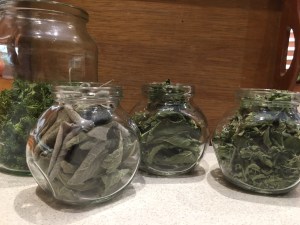
Our new electric dehydrator has been whirring away almost constantly in the laundry and has produced an array of delicious dried goodies, as well as the most incredible aromas when you step in to put on a load of washing. Home-dried raisins have graced a Herbscheese board, dried mango, banana, apple and pear will make scrumptious snacks, cereal toppings and cake ingredients. Veritable seas of parsley, sage, mint and oregano sway in the veggie patch and these have also dried beautifully, creating a collection of jars filled with multi-hued green piquancy that will last long after the frost finishes off their living relatives.
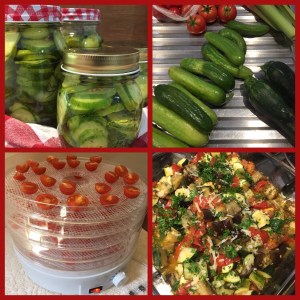
But perhaps my favourite experiment in this preserving paradise has been the dried tomatoes I made last week. In deference to space limitations, we planted only three varieties of tomatoes this year, just a couple of plants of each: Sweet Bite, a beautiful fruit that lives up to its name, sized somewhere between a cherry tomato and a small regular tomato; Italian Heritage, a good looking ribbed tomato with rich flavour but which hasn’t been as productive as the others – in part due to the soil still needing more work; and the old-fashioned favourite Grosse Lisse, which produces large, juicy tomatoes of the kind that were once the only type you could buy in Australian shops.

From Top L: Cucumber pickles, today's pick, dehydrating tomatoes, zucchini & tomato bake

Clockwise from Top L: Cucumber pickles, today’s pick, dehydrating tomatoes, zucchini & tomato bake

The Sweet Bite, when sliced in half, semi-dried beautifully in the dehydrator. Since it isn’t totally dried, I’m storing zip lock bagsful in the freezer and jazzing them up just before we want to eat them. Using only instinct as my recipe, I served up a small bowl of these incredibly tasty morsels the other night when friends came to dinner and the verdict was unanimous – simply the BEST semi-dried tomatoes any of us has ever tasted. It’s easy: bring the tomatoes to room temperature in a shallow-ish bowl; pour a little extra virgin olive oil over them – don’t skimp on the quality! You want enough oil to generously coat the tomatoes without them swimming in it. Add a little freshly crushed garlic – not so much that you overpower the sublime flavour of the fruit – along with a little crumbled, dried oregano (from our garden of course but failing that, some chopped fresh oregano or basil would be preferable to the commercially dried stuff, which is too pungent). Season lightly with salt & fresh ground black pepper and gently toss everything together. Let it all macerate for about an hour and …. rapture! I don’t ever want to go back to the bought variety but until we have our much bigger tomato patch next year, eventually we’ll have to buy or do without.

I’d best be off now … black grapes were on special today at the produce market and they’re waiting to be turned into raisins. It’s exhausting, this retirement business. But it tastes so good 🙂


The month of the sheep

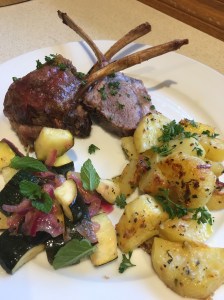
Sheep and lamb have been much on the agenda around here this past couple of weeks … and not only because of the latest, rather controversial, Australia Day lamb promotion  Lambassador. My regular followers (and the three of you know who you are) will recall I wrote about Tuki Trout Farm recently … which is also the home of Tuki lamb. After lunching there last week, we carried home our Tuki provisions and a couple of nights ago we gorged on some of the haul – the best roast rack of lamb I’ve ever cooked. Ok, to be honest it’s only about the second one I’ve ever cooked. And I was seriously put off by my last shot, as Filipino butchers don’t remove the chine bone (the very rigid, heavy-duty bone along the bottom of the rack, that joins the whole thing together and makes it impossible to carve individual cutlets unless you happen to be carrying a bandsaw around with you).

When Tuki’s Robert Jones told us they had lamb racks, the MOTH was sold straight away. I was a little more reticent … mostly about that chine bone. A quick chat with the ever-amenable Robert assured me that they remove it at Tuki so I had nothing to fear. He went on to give advice about getting the best out of the cut: “Rub it with a little oliveLamb Rack oil, sprinkle with salt and pepper and let it sit for a couple of hours. Then into a preheated oven around 200C for 45-60 minutes,” (depending on how “done” you like your lamb – 45-50 minutes is perfect for us, for a ten point rack). Crisp skin, tender and pink meat. Heaven!! Ably supported by some garlicky, herby, parmesan roasted potatoes and homegrown roasted zucchini with mint & lemon (all herbs grown right here at the Allan Street Flower and Veggie Collective, of course; lemons from my brother, aka Baby Bear). An altogether amazing meal and a wonderful showcase for seriously good produce.

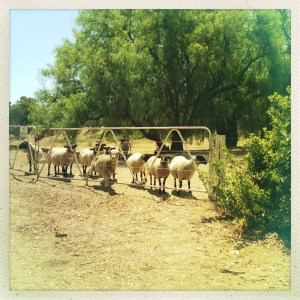
The other sheep connection came from the MOTH’s blog earlier this month, when he was paid a mid-day visit by a small flock. I was away on what he describes as a nuts-and-berries-gathering expedition, while himself was busy being a lumberjack in the wilds of our back block. I was on the road between berry bushes when I heard a text message, which I duly checked at the next stop. “We just had visitors,” it announced – and attached was a photo of a woolly mob hanging sheepishly around our driveway and looking like they knew they’d just been caught trespassing. Fifteen sheep – we presume a small flock from a local holding – had busted out of their fences and dropped in at the Allan Street Flower and Veggie Collective. The MOTH, mindful of the vulnerable and sheep-tasty native saplings he’d recently planted in the back block, was swift to herd them on their way. He rounded them up, encouraging them down the driveway and back from whence they came (then contacted the local ranger, to try to reunite the ovine escapees with their rightful owner).

Which reminded me of another time we rounded up sheep …

Three years ago, on our mission to find the ideal retirement spot, the MOTH and I headed to the tiny NSW town of Binalong, where the former railway station was for sale. Long decommissioned as an operating station, the building had been converted to a residence and partially restored. From the online real estate photos and given the asking price, it looked like it had potential. We were due for our annual “escape from Manila” routine (aka “home travel – enabling staff to reconnect with their own culture,”) so we decided to view the property. Amongst other things, the station was where the youthful Banjo Paterson would have arrived home by train, on holidays from a Sydney boarding school, and that added another level of interest for us. So we winged our way to Sydney, picked up a hire car and began what became known as “The Great NSW (and lesser Victorian) Road Trip”.

iPhone 14Mar13 166We set up an appointment to inspect the station and drove into Binalong on a hot, dusty February day. We checked in to the Royal Tara Motel (“Conference and Convention Centre” in slightly smaller letters), unpacked our bags and headed to the Railway Station for our first proper look at the place that had captured our imagination and prompted our impulsive departure from Manila. We were hoping for an unequivocal ‘wow’ moment as soon as we stepped inside the place and whilst we were slightly impressed, it wasn’t quite the must-buy experience we’d wished for. The house was a delight but there was still a lot of restoration and renovation to be done, despite evidence of much hard work by the current owners over the previous 17 years. And the village, where we would spend our retirement – potentially thirty years, the last stretch of our lives – wasn’t quite our cup of tea.
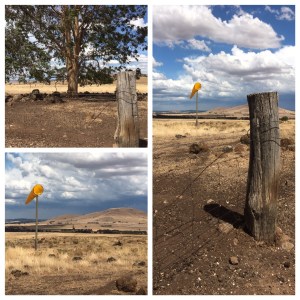
But we decided a cup of tea in the village was precisely what we needed once we said goodbye to the agent. After a bite to eat at the general store and café, we strolled past the Binalong Hotel, front verandah already abuzz with locals settling in for the first few beers of the day. We wanted a second look at the station – outside at least, as the agent had now long departed. Perhaps wandering around the unoccupied property and soaking up the character might cause a decision to drop upon us from the sky.

The current owners were using the property as a weekender and kept a dozen or so black-faced sheep, which grazed on the 10 acres of land immediately behind the spread. Entering the back garden we were greeted by the sight of five of those sheep trotting around the house yard, and we wondered if they were meant to be there. Observing one of them munching heartily on the grape vines and another fearlessly demolishing a thorny rose bush made us think they probably weren’t.

A quick scan of the garden’s perimeter revealed that a small gate we’d passed through earlier had been left open, allowing them in. And so with a sense of reluctant obligation and a brief curse that the agent didn’t properly close the gate, we set about the task of playing sheep dogs to round up the silly creatures. It proved to be an effective way of working off lunch as we both tore around, trying to shoo them back through the gate. One sheep slipped through almost immediately as if sensing the game was up, but the others bunched up and dashed hither and thither, despite our clumsy, perspiring attempts to guide them where we wanted. Another sheep eventually leaped off the edge of the station platform near an old railway carriage that was part of the deal. Mercifully it didn’t break its stupid neck or legs, and the route returned it to the rest of the mob out the back, who were by now closely watching the comedy routine.

After a few more attempts that would have any self-respecting kelpie laughing in his kibble, the MOTH announced a change of strategy: The gate was too hard as they could still run in several directions and there weren’t enough of us to ‘surround’ them effectively.  Instead, we would push them all towards the platform exit used by the recent deportee. Even if they didn’t go over the edge we figured at least we could corner them this way, though I’m not sure what we planned to do with them once we did.

iPhone 14Mar13 163

Of course, the moment we began moving to implement our new plan, the three remaining sheep trotted through the open gate in an orderly line and I swear I heard bleating that sounded like a mocking giggle.  We beat a hasty and sweaty retreat back to the motel to cool off with a couple of cold beers, and to check out alternative real estate options.  What else is a pair of incompetent shepherds to do?


Windmills and fresh fish

IMG_2361

Around this time last year I enjoyed reading an article from Melbourne journalist Andrew Masterson, on the “locavore” food movement (check it out here ). Locavores aim to source as much of their food as possible from as close to home as they can. From his home base in central Victoria, Masterson tells of his family’s self-imposed experiment to eat locally for seven days and describes the challenges and rewards they met during that week.

The article caught my attention for a number of reasons, not least of which because I’m passionate about food! Have I mentioned that I’m passionate about food? The MOTH has suggested I’m obsessed but we’ve agreed to differ on terminology. The other hook was timing: literally a couple of weeks earlier we’d sealed the deal to buy our own place in central Victoria so I was enthused by the useful food sources detailed in the commentary. I made mental notes of lots of them but one in particular caught my fancy: Tuki Trout Farm at Stoney Rises – a large farming property near Smeaton, just east of the renowned mineral spa town of Daylesford. Tuki offers catch-your-own trout activities for families – you can take them home or they’ll cook them for you (the trout, not the families). There’s also top quality beef and lamb, cottage accommodation for a luxurious retreat, and a licensed restaurant that showcases all their marvellous produce. I had it firmly ear-marked for a visit once we got ourselves settled at Buninyong.

After an early (I mean really early) start to deliver house guests back to the airport on the outskirts of Melbourne yesterday, we decided not to come straight home but to spend time discovering a chunk of the nearby countryside. We spent the morning strolling around the Daylesford township (predictably dropping in to Wombat Hill Nursery, where we adopted another litter of native trees and shrubs for our ever-expanding bush planting), then turned the car homewards and hoped to find a worthy spot along the way to satisfy a well-developed lunch appetite.

IMG_2360Trundling along narrow, rain soaked roads we passed a sign pointing to Tuki Trout Farm and decided it was time for that long-promised visit. The farm is very much a working property; if we’d been in any doubt, the long drive from the gate of the property to the stable building that houses the restaurant would have convinced us. Grazing sheep, iconic windmills, remnant timber cattle ramps and yards – all offered irresistible photo opportunities. With blue skies and fluffy white clouds in one direction and magnificent, moody grey storm skies in another, it was a feast for the eye and the lens.

The late Don Jones lived on Stoney Rises from the 1940s and his wife and children created the Tuki concept when they opened the farm to guests as a trout fishing venue in 1985. The name came from the Tukidale sheep grazing the farm at that time. During the 1990s a number of stone cottages were constructed to provide guest accommodation. Don’s son Robert and his wife Jan still live there and run Tuki, with help from their sons David and Alistair. When we called to check they had a table available, Alistair responded with “I’ll let Mum know you’ll be here soon.”

Mum Jan greeted and seated us and brought us chilled local beer and white wine, along with the menu. I love a restaurant that has what I call a focussed menu and Tuki’s is precisely that: they offer only three appetisers, all centred around their amazing trout, hot smoked to tantalising deliciousness, and their Tuki lamb smoked sausage – a cured delight somewhere between kabana and chorizo. Only three mains are offered too: fresh baked rainbow trout, Tuki lamb tenderloin fillets or a variety of Tuki steaks.

Now, we’d heard good things about the Tuki lamb and beef but trout was what we had in mind. We shared the smoked trout pate for starters – light and fluffy with a hint of horseradish, and a generous serve of crackers to spread it on. The portion was perfect for two and tasted divine. The fresh baked trout was a no-brainer choice for our mains and we later learned that when they say fresh, they mean fresh – after we ordered, chef Robert popped out and caught our two fish, seasoned them, and wrapped them in foil for their rendez vous with the oven. From hook to oven was just ten minutes, Robert told us as he presented a tray bearing the two silver packages and left them to rest for a few minutes. When he returned he skilfully deboned them with two Bar-b-Mates, slid the delicate pink fillets onto our plates and drizzled them with the flavour drenched oil and juices from the foil.

IMG_2358Eating those trout was practically a religious experience – they were exquisite. Flavoursome, cooked to perfection and redolent with the beautiful spring water they were so recently swimming in. A squeeze of lemon and a trickle of creamy, home-made, crushed green peppercorn dressing made for a heavenly taste. This amazing fish needed nothing more than locally grown potatoes and a mixed salad to accompany it. Oh, except perhaps the scrumptious, locally baked bread. There was that!
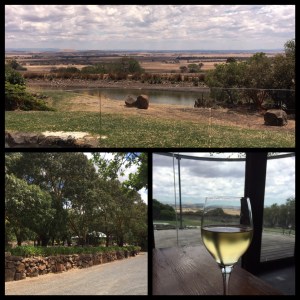

We didn’t really have room for dessert but bravely decided we could probably manage to share a serve of the Lemon Syrup Cake (“a rich butter cake drowned in a citrus syrup, cream and ice cream”) with some plunger coffee. We ought to have been grateful when Jan told us she had just run out of the lemon cake but we merely saw it as a good reason to return soon 🙂

Tuki sells all its produce on site and we came away with our own smoked trout, a stick of the rich, red, smoked lamb sausage and a handsome pair of racks of lamb, nestled together like a cathedral skeleton. Robert seems to be everywhere and yet never appears pressured, always having time to chat as he serves your trout, takes you to the butchering cool room to see which cuts of beef and lamb are available that day, and even providing tips on getting the most succulent lamb rack with a crispy skin. The friendly and easy-going hospitality is as good a reason to go back as the food itself. The view from our table, across the trout ponds and over magnificent farming land, rounded out the spotless experience.

IMG_2359

From the pond to the pan, from the paddock to the plate – the Tuki website points out that there are no food miles when you dine there. And luckily for us, there are still very few when we bring their exquisite produce to dine on at home. The locavores would surely approve 🙂

Check out Tuki here.

2015 Retrospective (Part 2)

Now moving into the second half of our action packed year … hopefully you’ve had time to make a cup of tea .. or pour a glass of something stronger!iPhone 141015 423

July was hectic as we culled and sorted at our over-sized Manila house, filled with far too many possessions. Pack-up week finally arrived and we farewelled our belongings, 283 cardboard-wrapped packages of varying size and shape, as they were loaded into a forty foot container. We moved to a hotel later that day and collapsed wearily to begin the count down for the last three weeks of our life in the Philippines.

As we boarded our flight home on August 1 it was eight and a half years to the day since we’d arrived in Manila – a long time to live anywhere, and particularly for a pair of nomads like the MOTH and me. If we hadn’t been so eager to get home, we may have felt a touch more nostalgic about leaving. We landed in Melbourne the next morning and drove to Geelong, where the MOTH finally got to meet our granddaughter Eve for the first time. Without delaying too much we hit the road again so he could at last see the house we’d bought! He’d been happy to rely on my judgement when I bought it, and describes the process as a “high trust model”!! Lucky for me, he loves it 🙂

We collected our new car the next day and to fill some of the waiting time till our shipment arrived from Manila, we headed off shortly afterwards on a NSW mini road trip. We visited Justin and Katherine in Bathurst and youngest son Aaron in Sydney’s west. A few nights with dear friends James and Dan, also in Sydney, then a lovely rendez vous with Nigel’s cousin Ivor and wife Kathy in Hill Top, rounded out the trip.

iPhone 141015 552Once our furniture arrived, all the free time we thought we’d discovered seemed to mysteriously evaporate and a frantic few weeks ensued as we unpacked and found new spaces for most of our belongings. If you ignore the hundred or so boxes still sitting in our (thankfully large) shed, we were pretty well organised by October so we headed to Darwin for another catch up with Kate et al, then down to Perth so the MOTH could visit his dear old mum.

The weather finally warmed up and we turned our thoughts to the garden. With just over 5000 square metres of land (a little more than one and a quarter acres) there’s always plenty to do and we’ve got lots of plans for our little piece of paradise. Neglected fruit trees needed our attention, we began planting herbs and vegetables for our kitchen garden and added to the collection of native trees and shrubs, to encourage more birds into the garden. Of course, this gives us something else to do as we now have to find ways of protecting the fruit and vegetables from said birds!!

In early December I made one more quick trip to Darwin. Answering the phone one day back in August, a small voice announced, “Hello, Nanna. It’s me – Liam! I’m calling to invite you to my birthday.” How could I possibly not accept an invitation like that from our littlest and cheekiest grandson? Of course, for the sake of equity I now find myself anticipating another trip in May, for his big brother Josh’s birthday ❤

We’ve been privileged to receive a parade of house guests since our furniture arrived and it reminds us of our good fortune in having so many fantastic friends who want to come and inspect our new kennel. We loved welcoming Harriet, then Ally and Enzo, followed by Jackie, Anne, Ching and Bruce, then Anne again together with Scott. Of course, all of our kids have already been to check out the new digs too. My brother David and sis-in-law Jenny have been regular visitors, as is only fitting: they were our proxies during the buying process, when we were stuck thousands of kilometres away in Manila and needed someone “on the ground” to attend to matters both petty and crucial. It’s fairly safe to say we couldn’t have done it without them – 😘

Welcoming family and friends into our home to celebrate Christmas was a splendid end to an incredibly dynamic year. As 2016 gets underway, we still spend much time marvelling at how good life is. We wish all of you a happy, healthy and harmonious new year.